1. Introduction to Brain Photobiomodulation
Photobiomodulation (PBM, formerly low‑level‑light‑therapy LLLT) delivers low‑energy red / near‑infrared photons to biological tissues without producing destructive thermal damagePMC. When applied transcranially via a helmet, NIR light penetrates scalp and skull to reach underlying brain tissue. The primary cellular target is mitochondrial cytochrome‑c‑oxidase (CCO). Light absorption boosts adenosine‑triphosphate (ATP) production, lowers oxidative stress, inhibits apoptosis, and modulates neuro‑inflammatory microglial responsesPubMed. It can foster neurogenesis, synaptogenesis, improve regional cerebral blood flow, and regulate neural circuit activity across multiple brain regionsPBM Founda....
Since around 2018, 810 nm and 1070 nm wavelengths have become widely studied for transcranial applications.
- 810 nm: Near‑infrared light faintly visible in dark environments; strongly absorbed by mitochondrial CCO complex.
- 1070 nm: Invisible NIR light (cannot be captured by regular cameras); relies on specialized detection cards for verification; offers different tissue‑penetration and ion‑channel‑modulating biological effects compared to 810 nmVielight.
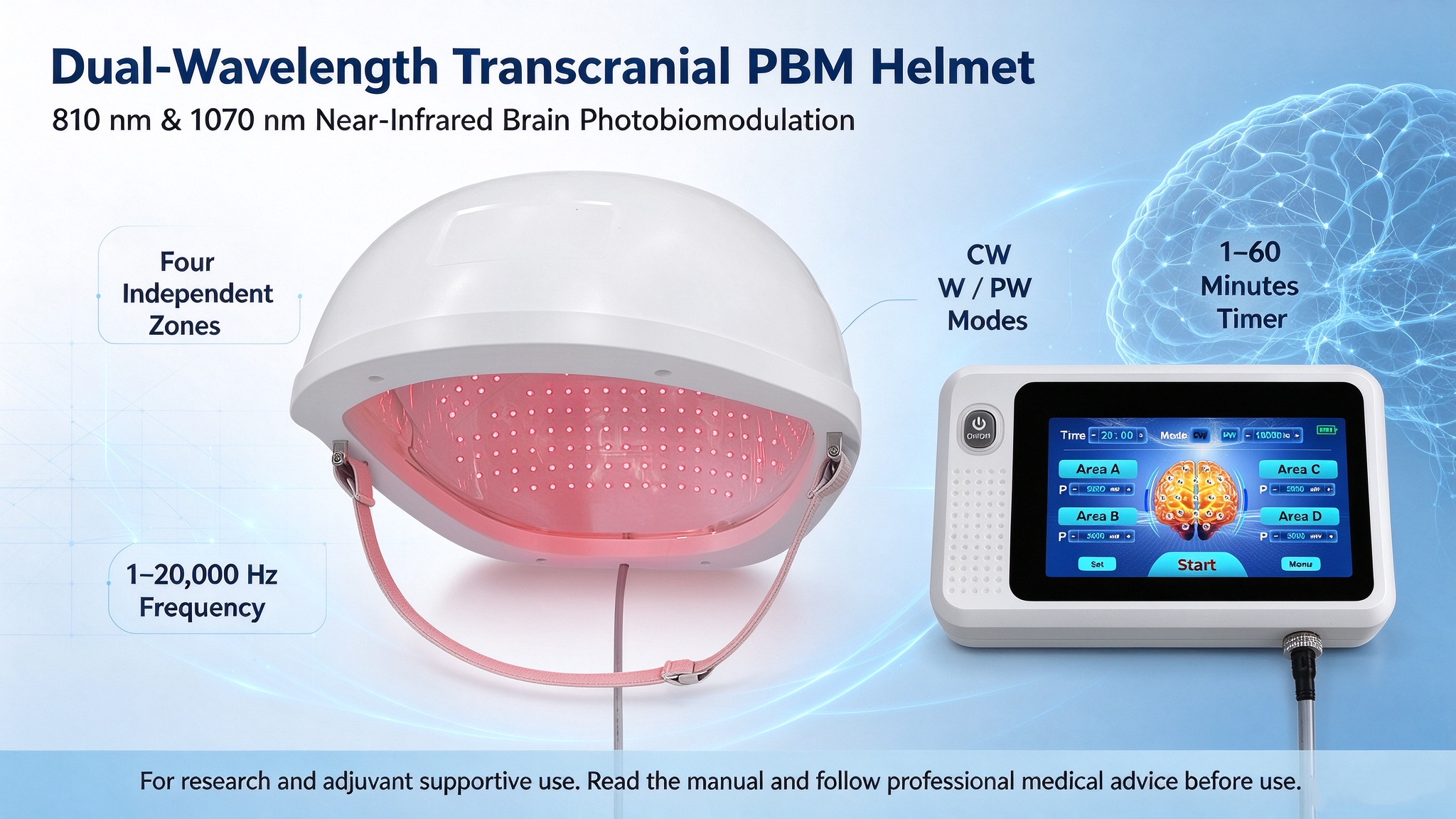
The 810 nm /1070 nm PBM helmet is designed for targeted or whole‑brain stimulation, dividing the scalp into four independently‑controlled treatment zones mapped to major cerebral lobes:
- Area A: Frontal Lobe (cognition, decision‑making, emotional regulation)
- Area B: Parietal Lobe (spatial awareness, sensory integration)
- Area C: Occipital Lobe (visual processing, sleep‑related circuits)
- Area D: Temporal Lobe (memory, language, emotional processing)
Each zone can run separately or simultaneously. Operators can select continuous‑wave (constant illumination) or pulsed‑wave (intermittent flashing; preferred for most applications except nerve regeneration) with tunable output power and pulse frequency, plus 10 preset customizable therapy programs stored in the controller unit.
2. Biological Mechanisms of Transcranial NIR PBM
When near‑infrared photons reach brain cells:
- Mitochondrial respiration complexes absorb light energy, raising ATP synthesis to restore neuronal energy statusPubMed.
- Down‑regulation of pro‑inflammatory signaling pathways, reducing excessive microglial activation linked to neurodegeneration and brain injuryPubMed.
- Anti‑apoptotic protection to limit neuronal cell death after ischemia or trauma.
- Promotion of neurogenesis and synaptogenesis, supporting neural plasticity for injury recovery and memory function.
- Modulation of cerebral blood perfusion and glymphatic clearance to clear metabolic waste from brain tissuePMC.
Pulsed‑wave mode adds rhythmic neural modulation. Frequencies like 10 Hz and 40 Hz are frequently reported in published protocols for Parkinson’s, Alzheimer’s, memory decline and mood‑related conditionsPMC.
3. Potential Clinical Application Scenarios
According to device guidance and peer‑review literature, transcranial PBM may offer adjuvant supportive benefits for the following neurological and psychiatric conditions (not intended to replace standard medical care)PBM Founda...:
Neurodegenerative Disorders
- Alzheimer’s Disease & Dementia: Target temporal, frontal and parietal lobes; 40 Hz pulsed mode may support memory retention, cognitive performance and reduce neuro‑inflammatory loadPubMed.
- Parkinson’s Disease: Stimulate frontal + temporal regions at 10 Hz or 40 Hz pulse to assist dopaminergic pathway support and motor‑symptom relief.
- Brain Atrophy: Multi‑lobe stimulation to enhance cerebral circulation and cortical cellular metabolism.
Acquired Brain Injury & Vascular Conditions
- Stroke Post‑Recovery: Parietal + frontal‑lobe pulsed therapy to promote neuroplasticity and sensory‑motor rehabilitation. Early clinical stroke trials using NIR light demonstrated good safety profiles, though outcomes varied with light‑penetration depth and treatment timingPMC.
- Traumatic Brain Injury (TBI): Combined frontal‑occipital‑temporal‑zone sessions for cognitive recovery, reducing post‑injury neuro‑inflammation.
Mental‑Health, Sleep & Cognitive‑Related Conditions
- Depression, Anxiety, PTSD: Frontal + temporal‑lobe pulsed protocols (8‑10 Hz) to modulate fronto‑limbic emotional circuits; pre‑clinical PTSD models have shown positive effects for pulsed‑810 nm transcranial stimulationPMC.
- Insomnia: Evening frontal‑temporal sessions to support relaxation and melatonin‑related sleep‑cycle regulation.
- Memory Impairment & Brain Fog: Frontal‑temporal or frontal‑occipital stimulation to improve alertness and cognitive processing speed.
- Chronic Migraine: Occipital‑temporal‑zone pulsed therapy for vascular regulation and neural‑inflammation reduction.
- Autism Spectrum Disorder & ADHD: Target frontal and temporal lobes to support attention, impulse‑control and social‑emotional processing.
4. Device Operation Overview
The helmet system includes LED helmet, touch‑screen controller, protective goggles, power‑supply adapter and hard carrying case.
Key technical parameters:
- Wavelengths: 810 nm, 1070 nm
- Modes: Continuous Wave (CW), Pulsed Wave (PW: frequency adjustable 1‑20000 Hz)
- Power per zone: 810 nm:1‑6000 mW; 1070 nm:1‑9000 mW
- Timer range: 1‑60 minutes per session
- Battery: Rechargeable 10000 mAh lithium‑ion battery
- Four independent treatment zones (A‑D) mapped to brain lobes
- 10 customizable saved therapy protocols
Basic operating workflow:
- Connect controller and helmet, long‑press power button to boot up.
- Select working mode: CW or PW (frequency setting only active under PW).
- Enable desired brain zones and adjust output power for each active area.
- Set pulse‑frequency (PW‑mode only) and treatment time.
- Adjust screen brightness / system audio volume if needed.
- Place helmet securely on head, wear included protective goggles.
- Tap “Start” to launch therapy; unit auto‑stops when countdown completes.
- Users can save custom parameter sets to one of ten preset program slots for repeated use.
Practical observation note: 810 nm light is faintly visible in darkness. 1070 nm produces no visible glow even during normal working status; this is expected hardware behavior.
5. Safety, Warnings & Contraindications
This PBM helmet complies with IEC/EN 60825‑1:2014 laser‑product safety standard. Near‑infrared light can injure unprotected eyes. Always wear protective goggles while the helmet is active.
Major contraindications:
- Pregnancy, infants and children younger than 13 years old
- Patients with implanted pacemaker hardware
- Light‑triggered seizure disorders
- Body fever > 38 °C /100.4 °F
- Active carcinoma (insufficient clinical safety data)
- Do NOT shine light directly onto throat / thyroid area.
- Avoid skin lotions or oils on scalp within 30 minutes before sessions (risk of photosensitization).
Important safety tips:
- Do not exceed 60 minutes per single treatment session unless directed by a physician.
- If you develop dizziness, headache or skin discomfort, stop treatment immediately and consult a clinician.
- Never disassemble the helmet or controller electronics; keep away from water and heat sources.
- Use only the manufacturer‑supplied AC power adapter for charging.
6. Conclusion
The dual‑wavelength 810 nm /1070 nm multi‑zone transcranial PBM helmet represents a flexible non‑invasive tool for brain photobiomodulation research and home‑adjuvant‑use. Independent lobe‑targeting, dual CW/PW modes, wide power‑frequency‑time adjustment range allow custom‑tailored therapy parameters for different neurological and cognitive concerns.
Existing pre‑clinical and early human pilot studies support the biological plausibility of tPBM for neuroprotection, cognitive support and mood‑modulation. Nevertheless, larger‑scale randomized controlled human trials are still needed to fully standardize optimal dosage protocols and validate definitive clinical efficacy for most brain‑disease indications.
Disclaimer Re‑statement: All content is educational review material, not medical guidance. PBM therapy should be used as complementary support only, never to replace prescribed clinical treatments. All users must obtain advice from qualified medical professionals before commencing photobiomodulation therapy.
Selected Peer‑Reviewed Literature References (for website citation)
- Hamblin M.R. (2016). Shining light on the head: Photobiomodulation for brain disorders. BBA Clinical, Volume 6, Pages 112‑124. PMID:27752476PubMed.
Classic foundational review covering transcranial‑PBM mechanisms, LED‑helmet concepts and broad disease indications.
- Shen Q, Guo H, Yan Y. (2024). Photobiomodulation for Neurodegenerative Diseases: A Scoping Review. International Journal of Molecular Sciences, 25(3), 1625. DOI:10.3390/ijms25031625PMC.
Scoping review summarizing pre‑clinical and early‑clinical findings for Alzheimer’s, Parkinson’s and other neurodegenerative disorders.
- Fernandes F, Oliveira S, Monteiro F, et al. (2025). Devices used for photobiomodulation of the brain‑a comprehensive and systematic review. Journal of NeuroEngineering and Rehabilitation, 22(1)..
Systematic review comparing helmet‑type and other transcranial‑PBM hardware; discusses 810 nm and longer‑NIR‑wavelength characteristics, CW / pulsed‑mode parameters.
- Berman M.H., Halper J.P., Nichols T.W., et al. (2017). Photobiomodulation with Near Infrared Light Helmet in a Pilot, Placebo‑Controlled Clinical Trial in Dementia Patients Testing Memory and Cognition. Journal of Alzheimer’s Disease Reports, 1(1):11‑18. PMID:28593105PubMed.
Pilot placebo‑controlled human helmet study for dementia / cognitive‑decline subjects using near‑infrared helmet technology.
- Salehpour F, Mahmoudi J, Kamari F, et al. (2018). Brain Photobiomodulation Therapy: A Narrative Review. Molecular Neurobiology, 55(8):6601‑6636. DOI:10.1007/s12035‑017‑0852‑4Frontiers.
Large narrative review covering TBI, stroke, mood‑disorders, wavelengths, pulsed‑frequency selection for brain‑PBM protocols.
- Zhang J, Zhang Q, Jordan J.D., et al. (2026). Near‑Infrared Photobiomodulation in White‑Matter Disease: From Microglial States to Measurable Endpoints. Neuromolecular Medicine, 28(1):41. PMID:42377668PubMed.
Explores NIR‑PBM effects on microglia, neuro‑inflammation; compares ~810 nm versus ~1070 nm‑range wavelength biological pathways.
- Ando T, Xuan W, Xu T, et al. (2011). Comparison of therapeutic effects between pulsed and continuous‑wave 810‑nm wavelength laser irradiation for traumatic brain injury in mice. PLOS ONE, 6(10):e26212. DOI:10.1371/journal.pone.0026212PMC.
Pre‑clinical animal study demonstrating biological‑response differences between pulsed‑wave and continuous‑wave 810 nm brain light‑therapy.
- Montazeri K, Farhadi M, Fekrazad R, et al. (2021). Transcranial photobiomodulation in the management of brain disorders. Journal of Photochemistry and Photobiology B‑Biology, 221,112240..
Systematic review summarizing human‑RCT evidence status for stroke, TBI, Alzheimer’s and Parkinson’s disease.